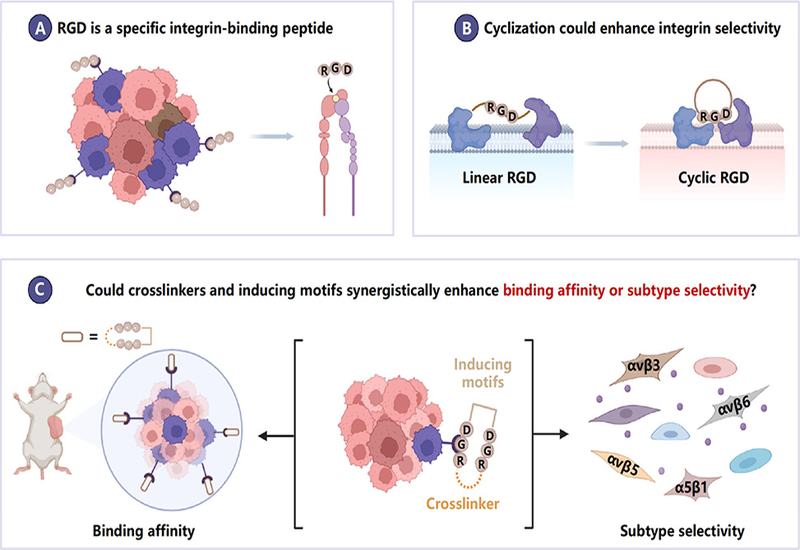
Integrins drive tumor angiogenesis, invasion, and metastasis, making them attractive targets for cancer imaging. RGD-based probes can bind integrin receptors and enable in vivo tumor visualization, but translating that affinity into diagnostic precision has proved difficult. The problem is structural: multiple integrin subtypes share highly conserved ligand-binding interfaces, so most RGD scaffolds engage αvβ3, αvβ6, α5β1, and αvβ5 with little discrimination. Without subtype selectivity, PET signals conflate distinct tumor biology and produce ambiguous diagnostic readouts. Constraining the RGD scaffold by cyclization improves selectivity in principle, yet the field has lacked a systematic framework for predicting which conformational features favor which subtype, leaving probe development largely empirical.
Researchers in the Wang and Hu Groups at the Chinese Academy of Medical Sciences & Peking Union Medical College, published in J. Med. Chem., built a 25-member cyclic RGD library by pairing five carbon-spacer cross-linkers with five β-turn-inducing motifs across a common scaffold. The central hypothesis was that cross-linker geometry and turn motif together control the conformational ensemble available to the RGD pharmacophore, and that subtle changes to either parameter would resculpt the binding surface presented to each integrin subtype. Biolayer interferometry screening against αvβ6, αvβ3, αvβ5, and α5β1 confirmed this reasoning: six peptides emerged with nanomolar apparent affinities and distinct subtype preferences. Circular dichroism analysis revealed that a rigid D-Pro-L-Pro motif promoted β-sheet character in the αvβ6-selective scaffolds, while a longer five-carbon spacer reshaped global scaffold topology to favor αvβ3, and a shorter three-carbon spacer preserved enough conformational flexibility to accommodate α5β1 recognition. Subtype-preferred leads were conjugated to DOTA and advanced as ⁶⁸Ga-labeled probes to PET/CT evaluation in xenograft models, where the αvβ6-targeted probe achieved higher tumor uptake than an established reference peptide.
The work provides a reusable design logic connecting cross-linker carbon count and turn motif to integrin-subtype preference, offering peptide chemists a concrete handle for navigating the conserved RGD binding landscape. A companion observation that αvβ3 scaffold selectivity held in vitro but eroded in vivo after chelator incorporation points to linker and chelator optimization as the next design challenge. Full binding data, conformational analyses, radiolabeling procedures, and PET/CT quantification are available in the original publication.